Sparse rainfall prolongs dry conditions, prompting localized water shortage

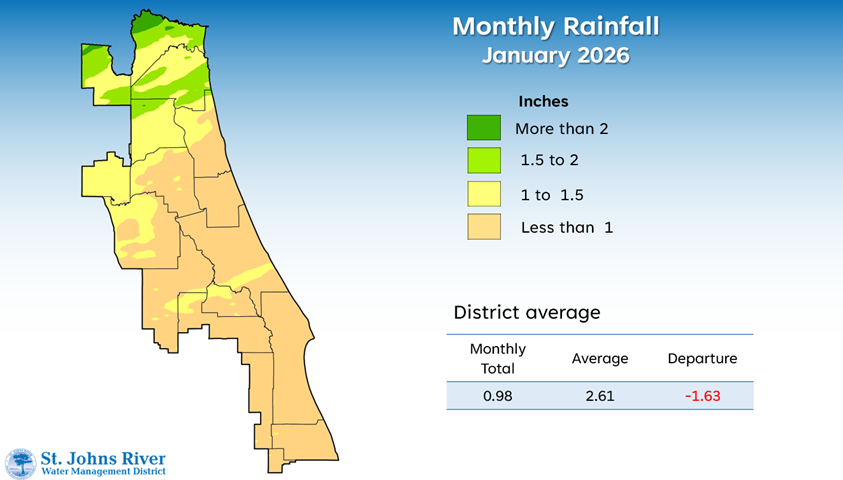
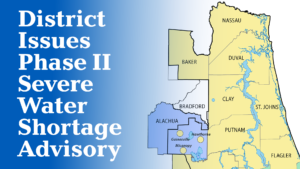
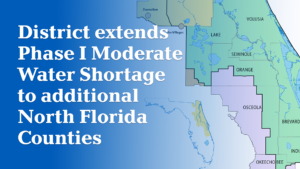
January brought little relief from the dry conditions across the St. Johns River Water Management District (District), with rainfall totals remaining sparse during what is typically one of the region’s drier times of year. Nearly all the area received below-average precipitation, and the entire District is experiencing some level of drought, according to the U.S. Drought Monitor. A water shortage has been declared for portions of the District, including Duval County and parts of Alachua, Baker, Bradford and Marion counties.
The National Weather Service short-term precipitation forecast calls for near-normal rainfall, while longer-term and seasonal outlooks indicate a higher probability of below-normal rainfall and above-normal temperatures, though some uncertainty remains.
With limited rainfall expected in the coming months, residents are encouraged to use water efficiently by following water restrictions and adopting smart irrigation practices.
A full report outlining January’s hydrologic conditions was presented at the District’s Governing Board meeting. Highlights include:
Rainfall
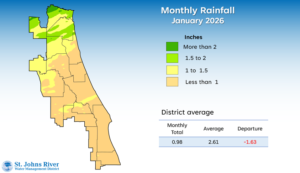
- Districtwide rainfall averaged 0.98 inches, 1.63 inches below the monthly average.
- Monthly averages ranged from 1.66 inches in Nassau County to 0.57 inches in Brevard County.
- Annual rainfall across the District was 43.95 inches, 7.06 inches below the long-term average.
- Rainfall distribution on an annual scale has been higher in Volusia, northern Brevard and portions of southern counties, while areas to the west and the northwest have received below 35 inches.
- Volusia was the only county that remained above normal rainfall for the year. Of the 17 counties that recorded below-average annual rainfall, eight were below their averages by 10 inches, including Baker and Bradford counties, which were more than 15 inches below their annual averages.
Groundwater
- Water levels in the Upper Floridan aquifer primarily recorded decreases, reflecting drier conditions.
- Districtwide groundwater levels, expressed as a single index, were in the 25th percentile for January, which is just within the normal range.
Spring flows
- Silver Springs recorded a monthly mean flow of 488 cubic feet per second (cfs), or 315 million gallons per day (mgd), a decrease of 12 cfs from December. Remaining in the low range for this time of year.
- In Volusia County, the Blue Spring station reported flows to be in the normal range.
- Rock Springs had a monthly mean flow of 59 cfs (38 mgd), which is in the normal range.
- Wekiwa Springs recorded a monthly mean flow of 64 cfs (42 mgd), continuing to be in the normal range.
For further insights into rainfall totals and other hydrologic data, visit sjrwmd.com/data/hydrologic/.
For more information about the Phase I Moderate Water Shortage, visit sjrwmd.com/wateringrestrictions.
Visit WaterLessFlorida.com for tips to help landscapes thrive while saving water and money. Follow the water conservation conversation at #sjrwmd #waterconservation #savewater.