

District sees unusually dry November as dry season sets in
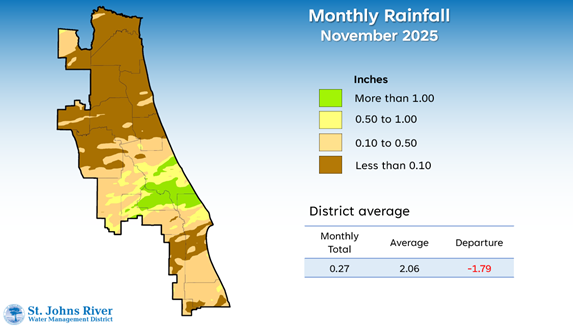
A map illustrates rainfall conditions in November across the St. Johns River Water Management District.
November brought unusually dry conditions across the District, with much of the region seeing little rainfall. Only limited areas in Brevard, Volusia and Seminole counties recorded more than an inch of rain, while parts of Duval and other northern counties saw none — a rarity documented only four times in the period of record at longstanding National Oceanic and Atmospheric Administration (NOAA) stations in Jacksonville and Orlando.
According to the U.S. Drought Monitor, drought remains limited in the District’s eastern region, but areas along the western boundary were classified as abnormally dry, and northwest counties were classified as having higher levels of drought. As the dry season continues, and with NOAA projecting that mild La Niña conditions will persist, the District will continue to monitor evolving conditions. Near-term forecasts from the National Weather Service indicate normal rainfall, while the three-month outlook shows an increased chance of below-average precipitation.
With limited rainfall expected in the coming months, residents are encouraged to use water efficiently, such as following water restrictions and adopting smart irrigation practices.
A full report outlining November’s hydrologic conditions was presented at the District’s Governing Board meeting. Highlights include:
Rainfall
- Districtwide rainfall averaged 0.27 inches, 1.79 inches below the monthly average.
- Monthly averages ranged from 1.23 inches in Seminole County to 0.01 inches in both Duval and Clay counties.
- Annual rainfall across the District was 46.07 inches, 4.94 inches below the long-term average.
- Rainfall distribution on an annual scale has been higher in Volusia, northern Brevard and portions of southern counties, while areas to the west and the northwest have received less.
- Fifteen counties have recorded below-average annual rainfall, with six counties more than 10 inches below their annual averages, including Baker County at more than 13 inches below its annual average.
Groundwater
- Water levels in the Upper Floridan aquifer primarily recorded decreases, with sites showing decreases that track along with recent rainfall patterns.
- Districtwide groundwater levels, expressed as a single index, were in the 39th percentile for November, which is in the normal range.
Spring flows
- Silver Springs recorded a monthly mean flow of 522 cubic feet per second (cfs), or 388 million gallons per day (mgd), a decrease of 24 cfs from November. Remaining in the low range for this time of year.
- In Volusia County, the Blue Spring station reported flows to be in the normal range.
- Rock Springs had a monthly mean flow of 61 cfs (39 mgd), which is in the normal range.
- Wekiwa Springs recorded a monthly mean flow of 66 cfs (42 mgd) continuing to be in the normal range.
For further insights into rainfall totals and other hydrologic data, visit www.sjrwmd.com.
Visit WaterLessFlorida.com for tips to help landscapes thrive while saving water and money. Follow the water conservation conversation at #sjrwmd #waterconservation #savewater.