Connected by Water: Lake Apopka’s impact
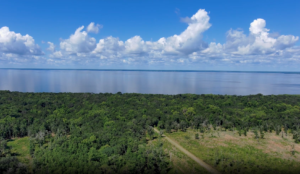
Lake Apopka is making a remarkable comeback. After nearly 40 years of restoration work, this central Florida lake is rebounding and the results are being felt not only in the water, but in the lives of people and wildlife that depend on it.
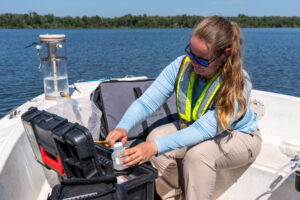
The St. Johns River Water Management District (District) and its partners have worked to improve the lake’s water quality and habitat, achieving results that are both measurable and meaningful.
Once known for fishing and tourism, the lake, which is the headwaters for the Harris Chain of Lakes, was once lined with more than 20 camps that offered boat rentals, lodging and entertainment. That all changed in the 1940s, when the wetlands were drained for farming during World War II to boost food production. Runoff from agriculture, sewage and even a peat mine led to the lake’s first major algae bloom in the late 1940s. The lake’s clear waters turned a murky green and shaded out aquatic plants and wildlife. By 1985, the decline was so severe, the Florida Legislature tasked the District with leading the lake’s restoration.
The District developed a multipronged, science-based approach to aid in the restoration of Lake Apopka. In 1996, the District purchased farms along the lake’s north shore, which were identified as a major source of phosphorus loading, placing the lake on a phosphorus “diet.” In 2003, an innovative 760-acre marsh flow-way system began operating, functioning as a natural filter that continuously removes algae, suspended solids (fine dirt and organic particles floating in the water), and excess nutrients from the water. The flow-way filters about 30% of the lake’s volume each year.
Another key restoration component has been the harvesting of gizzard shad, fish that recycle nutrients by consuming algae and releasing phosphorus back into the water. Each year, about 750,000 pounds of shad are removed from the lake. Since 1993, shad removal has resulted in more than 274,000 pounds of phosphorus being taken out of the lake.
The results speak for themselves. Since restoration efforts began, total phosphorus, a major contributor to harmful algal blooms, has declined by 67 percent and water clarity has improved by 66 percent. These improvements have allowed for submerged aquatic vegetation, an indication of a healthy aquatic environment, to naturally return to the lake’s bottom.
To help accelerate the recovery efforts, the District, with legislative support and in partnership with the Florida Fish and Wildlife Conservation Commission and the Florida Department of Environmental Protection, is actively planting native submerged aquatic vegetation in Lake Apopka. Many of these plants are now spreading on their own, a strong sign of recovery.
“The District has done an amazing job of reducing phosphorus, reducing invasive aquatic plants and increasing native aquatic vegetation,” says Joe Dunn, executive director of Friends of Lake Apopka, a community advocacy group dedicated to the lake’s restoration.
For Jim Peterson, the District’s strategic planning basin coordinator who has spent most of his career working on Lake Apopka, the progress is deeply meaningful. “I’m really proud that we are seeing the results of the restoration on Lake Apopka,” he says. “The District is going to continue that work.”
For long-time anglers, the transformation is personal. Daniel Whitehouse has been fishing on Lake Apopka for over 30 years and says the difference is night and day. “Anglers used to be limited to just a few spots,” he explains. “Now, you can fish the whole lake.” He’s caught bass weighing more than nine pounds and is still holding out hope for a ten-pounder. “There’s always tomorrow; or maybe today.”
But the benefits of restoration extend far beyond the water and the fish. Along the lake’s north shore, former muck farms that once contributed to the pollution of the lake have been transformed into a haven for outdoor recreation. In 2015, the Lake Apopka Wildlife Drive opened to the public, along with sections of the Lake Apopka Loop Trail. Together, they offer nearly 20 miles of scenic space for hiking, biking, birding and wildlife viewing.
Wes Parrish, who lives on the lake, has biked about 25,000 miles on the loop trail over the past six years. He’s out there three times a week, taking in the quiet, natural beauty. “Being on a bike, there’s no motor, no sound,” he says. “I hear the wind; I hear the birds. It’s being in nature the whole time you’re out there.”
“Being here in Winter Garden, just south of Lake Apopka, we’ve been riding around the lake for years,” says Dennis Jones, owner of the local bike shop Wheelworks Winter Garden. “We get a lot of tourists who rent bikes, and we steer quite of few of them up to Lake Apopka. They really enjoy that.”
Thanks to the habitat created by restored wetlands, Lake Apopka is now one of the top three eBird hotspots in the state, supporting over 370 bird species throughout the year and serving as an important stopover along migratory pathways. Kathy Rigling, a dedicated birder and education coordinator with Orange Audubon, visits the Wildlife Drive at least once a week. “Each season brings changes,” she says. “This is a place of refuge for birds that live here and for those passing through.”
As public access has expanded, the lake’s restoration has also begun to generate economic benefits for surrounding communities. Increased visitation is supporting eco-tourism, outdoor recreation and local businesses.
“When folks come here to check out the restoration efforts going on at Lake Apopka, whether it’s birding or bike riding, they come through our downtowns, they spend money in our local businesses, they get lunch at our local restaurants,” says Stephen Lewis, the executive director of the West Orange Chamber of Commerce. “It really helps drive the economy here.”
As the lake has improved, the surrounding communities are reconnecting with it. For years, the parks and public spaces around Lake Apopka were quiet. But now, more and more people are getting outside to experience the transformation for themselves. Mona Phipps, who has lived in the area since 1996, says she’s seen a rise in eco-tourism and community engagement. For residents like Phipps, the lake is no longer something to avoid—it’s a place to gather, reflect and reconnect with nature. “This [Lake Apopka] is my favorite sunset spot,” she says.
What was once acquired to stop nutrient pollution is now a treasured natural space. The restored wetlands of the North Shore provide crucial habitat for wildlife and a peaceful retreat for people
“Come see this resource, learn its history and think about what it took to get from where we were to where we are,” Phipps explains. “The bottom line is it took people caring.”
The story of Lake Apopka is ultimately a story of long-term commitment by scientists, policymakers, partners and the community.
To learn more, watch Connected by Water: Lake Apopka’s impact.