

Lake Apopka
Updated on 5/18/2026
Lake Apopka, the headwaters of the Ocklawaha Chain of Lakes, has undergone a transformation over the past few decades. Since the 1980s, the District and its partners have worked to improve the lake’s water quality and habitat, achieving significant improvements.
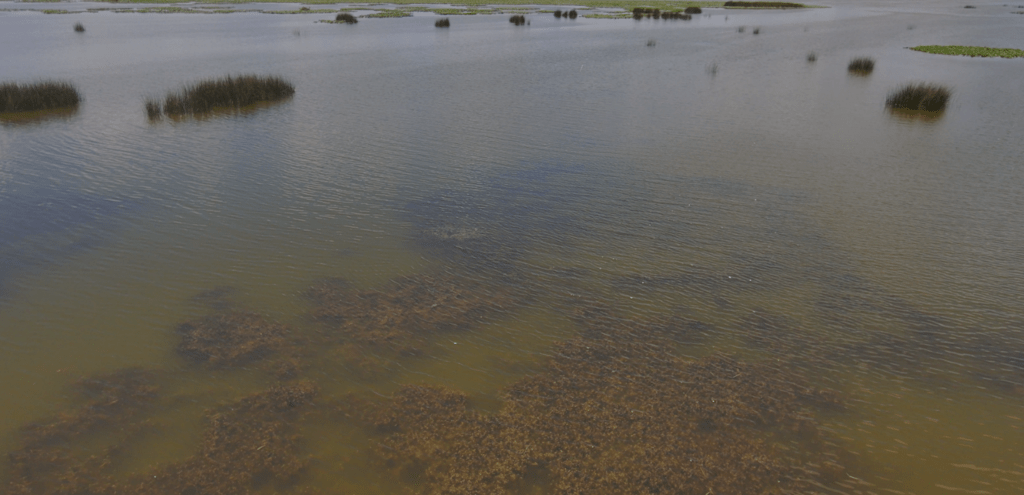
In 1994, there was no submerged aquatic vegetation (SAV) in Lake Apopka. As a result of the District’s restoration efforts, the 2024 survey found visible native SAV around 95% of the lake’s shoreline. More importantly, District staff have observed much of the SAV flowering. Flowering is important for two reasons: first, it is an indicator of good plant health, and second, the seeds provide for natural expansion of this important habitat. The return and continuing expansion of SAV indicates that water quality and clarity are improving. Native eelgrass and pondweed are now expanding into the lake’s open water areas, another promising sign for the ecosystem’s recovery. The increase in native SAV is critical, as it was both a predicted outcome of water quality improvements, and it provides critical sustainable habitat for fish and wildlife.
The lake’s improving health is not just good news for nature; it’s also great for anglers. Recent fishing tournaments in the Upper Ocklawaha River Basin Chain of Lakes have included Lake Apopka as a tournament lake. Additionally, the Florida Fish and Wildlife Conservation Commission (FWC) has documented a major increase in fishing activity in the lake. Bass caught from the lake have been impressive in size and abundance, making it a popular destination for many anglers.
Restoration in Action:
The restoration of Lake Apopka has focused on a multipronged approach: a “diet” to reduce phosphorus entering the lake, “exercise” to remove phosphorus already in the water, and “physical therapy” to help the lake cycle its nutrients.
Phosphorus Diet:
- A significant milestone occurred in 1996 when the state legislature directed the District to purchase farms on the lake’s north shore. These farms, originally floodplain marshes (wetlands) before being drained and diked for agricultural production in the 1940s, were a major source of phosphorus fueling algal blooms, which shaded the lake’s SAV. As the SAV disappeared, the historic bass population collapsed, as did the dozens of fish camps which once lined the lake’s shores.
- Key to reducing phosphorus loading from the North Shore was restoring the area’s wetlands to reduce the volume of phosphorus laden water entering the lake. Now, discharges are infrequent and can be treated to inactivate phosphorus, and in 2003 the passage of the Lake Apopka Stormwater Rule enhanced the lake’s diet to the entire watershed.
- Increased flexibility of water management across the North Shore has decreased pumping and has led to opportunities to create a mosaic of wetland and open water habitat.
Phosphorus Exercise:
- Efforts to remove phosphorus already in the lake include the annual rough fish harvest focused on gizzard shad. Harvesting gizzard shad has been an important factor in the improvement of water quality, with typically 750,000 pounds of shad removed annually. Since 1993, the shad removal equates to more than 274,000 pounds of phosphorus removed from the lake. Click here for more information.
- The Marsh Flow-Way is a 760-acre filter marsh that continuously removes algae, suspended solids, and nutrients from the lake’s water. Located in the southwest corner of the North Shore, the Marsh Flow-Way began operation in 2003 and filters about 30% of the lake’s volume each year. The stored solids are retained in the marsh’s soils, and the treated, clearer water is returned to the lake. Since operation began in 2003, more than 77,500 tons of total suspended solids, 1,500 tons of total nitrogen and 38.9 tons of total phosphorus have been removed from the lake. Click here for additional information.
Physical Therapy:
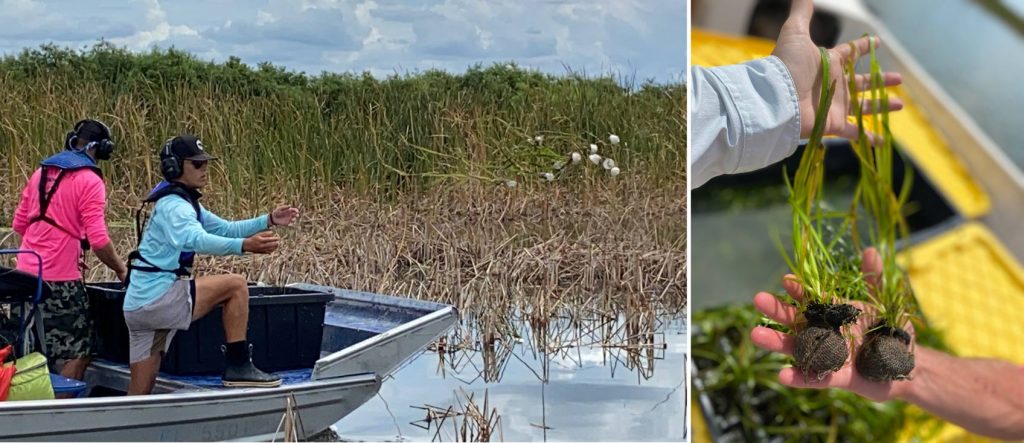
- As the water in Lake Apopka got clearer, SAV started growing again from the seedbank (seeds stored in the lake’s soil) showing that the water was clear enough to support plant life. SAV absorbs phosphorous from the water and the lake’s sediments. When there are large dense areas of SAV, they help clear the water by trapping suspended particles and stabilizing the lake bottom. The plants use the nutrients to grow, and as more plants grow, the water gets clearer, and more phosphorous is removed. The District, with FWC, Florida Department of Environmental Protection (DEP), and legislative support, began planting native SAV to accelerate the lake’s recovery of this critical habitat.
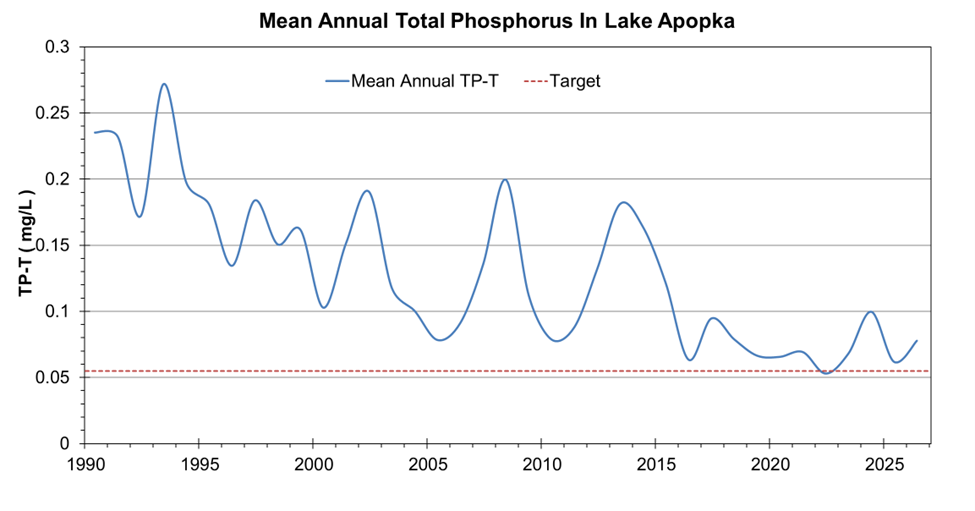
The combined effect of diet, exercise, and physical therapy has led to a dramatic improvement in water quality. Since the late 1980s, phosphorus concentrations have declined 66% and water clarity increased by 52% as of March 2026. In 2022, the annual average phosphorus concentration was below the target concentration for the first time. Although phosphorus levels have generally trended downward, periodic increases have occurred during times of low water levels. The current drought, which began during the summer of 2025, has resulted in many months of water levels below the regulation schedule, resulting in increased phosphorus concentrations. Despite these conditions, the lake’s native SAV continues to flourish and expand. Improved water clarity has allowed more sunlight into the water column, triggering the regrowth of SAV, which had been missing for 50 years, and restoring the critical bass habitat needed for recovering sportfish populations.
The current water quality illustrates that the District’s work to reduce phosphorus inputs, operate the Marsh Flow-Way and harvest rough fish will continue to support the long-term restoration efforts.
Ongoing projects:
- To further restrict the phosphorus diet, the District is implementing a series of projects to improve its ability to manage water on the North Shore’s recovering wetlands. Recent work completed on or about December 2025 included upgrading pump stations for remote operation, replacing all alum tanks, and upgrading alum pump systems across all pump stations. Additional projects scheduled for completion by December 2026 include:
- Regrading of the Wildlife Drive for safer and smoother access.
- Regrade treatment wetland and Sand Farm areas to provide additional storage and nutrient removal prior to discharging off these properties.
- Redirect flow from treatment wetland and Sand Farm areas to the Duda area to reduce nutrient exports from these areas to the McDonald Canal.
- Regrade and clean the Marsh Flow-Way pump basin to improve pumping efficiency which will increase overall functionality of the Marsh Flow-Way.
- Reconstruct several miles of the slopes adjacent to the lake to improve stabilization and wave attenuation. Most of this work is adjacent to the Loop Trail around Lake Apopka.
- A Nutrient Reduction Feasibility Study will be conducted in fiscal year 2025-2026 to look at potential projects to further reduce phosphorus in Lake Apopka and the Upper Ocklawaha River Basin Chain of Lakes.
- The District is expanding its physical therapy work to accelerate the recovery of native SAV in Lake Apopka by conducting additional plantings using District, FWC, and legislative resources:
- Planting native floating-leaved aquatic lilies and lotus. Recently, the District planted 28,382 lilies and lotus to provide submerged habitat on more than 10 acres of the lake. This project was in partnership with the DEP. The District will be planting more acreage of floating-leaved aquatic lilies and lotus in the future.
- Planting native SAV like eelgrass and Illinois pondweed. In coordination with our partners, DEP and FWC, 174 acres of SAV (880,039 plants of eelgrass and Illinois pondweed) have been planted in Lake Apopka since 2021. Future funding and SAV plantings are expected.
Recreation improvements:
- The District opened the West Marsh Recreation Area on the portion of the North Shore west of the Apopka-Beauclair Canal and north of the Marsh Flow-Way. Improvements included construction of a new parking area, installation of a canoe/kayak hand-launch site, and invasive plant treatments aimed to improve wetland habitat and create a network of open water paddling trails through dense aquatic vegetation. A free day-use permit is required to access the new parking area and canoe/kayak launch. Additional information on how to obtain a day-use permit can be found at: Recreational day-use permits – SJRWMD.
- The District also worked with FWC to allow catch-and-release fishing and seasonal public waterfowl hunting at the new recreation area. Additional details on fishing and hunting regulations for the newly established Lake Apopka North Shore Public Small Game Hunting Area can be found on FWC’s website here. Information on how to obtain a waterfowl quota hunt permit can be found here.
- The District and Orange Audubon celebrated the 11th anniversary of the Lake Apopka Wildlife Drive on May 3, 2026. This milestone marks over a decade of conservation and public engagement in this significant wetland restoration project. Thanks to ongoing efforts to restore the North Shore wetlands, wildlife, particularly birds, have responded with remarkable increases in both numbers and diversity. Today, the North Shore is recognized as one of Florida’s premier birding destinations and an e-bird hotspot, with 377 different bird species recorded on the property, highlighting the success of habitat restoration and its importance for biodiversity.
- The District is designing a dredging project in collaboration with the city of Winter Garden on the south side of Lake Apopka near the Newton Park Boat Ramp. The project’s goal is to improve boating access from the boat ramp to deeper parts of the lake.
Ongoing challenges:
While the lake’s native SAV is flourishing, invasive hydrilla expanded rapidly and the District and FWC successfully conducted large-scale hydrilla treatments in 2023 and 2024. These treatments returned the cover of this invasive species to the manageable levels it had occupied for years. Legislative support was crucial in funding these efforts. Management efforts are focused on maintaining hydrilla cover to low levels, which can be effectively addressed through small spot treatments by FWC. These efforts do not negatively affect the native SAV species and provide them with the opportunity to colonize and grow.