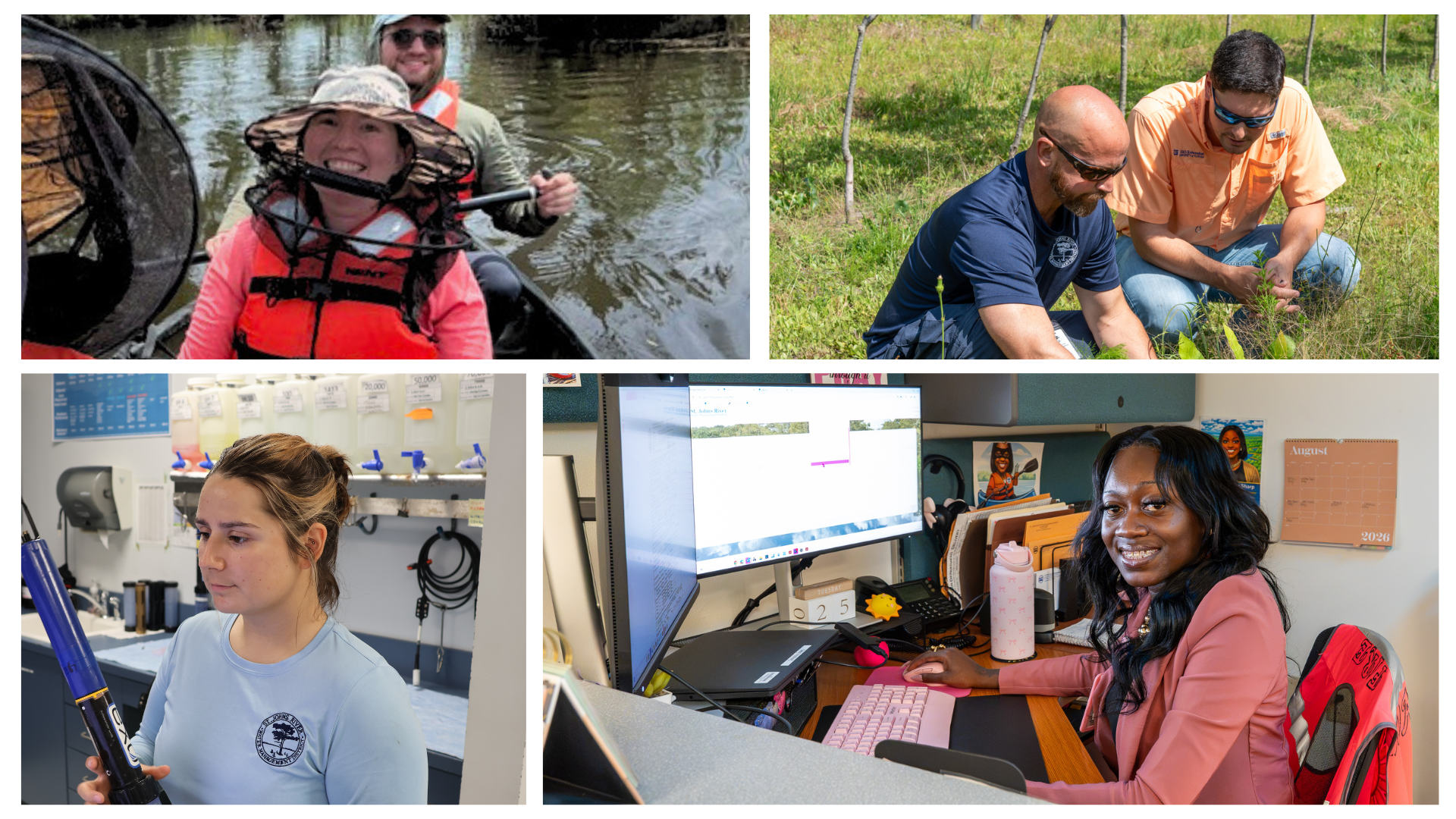
Conservation careers come in many forms. Some professionals spend their days in the field collecting water samples, while others analyze data, assist permit applicants or work directly with agricultural producers. What they share is a commitment to protecting the natural resources that support everyday life, business and the environment. In celebration of conservation careers, meet four District employees working to safeguard Florida’s natural resources.
Finding a passion for science
Shannan McAskill, Environmental Scientist, based out of the District Headquarters in Palatka, grew up in Florida dreaming of working as a paleontologist digging up dinosaurs. It wasn’t until college, when she landed a series of internships, that she found a new path in environmental sciences. An internship studying the interactions between invasive and native fish in the Everglades happened to coincide with her pursuit of a scuba certification. The result was a career and graduate studies focused on seagrass and fisheries.
Now with her PhD, McAskill works on water quality and oysters in coastal systems, a role that means some days she’s in the field; other days she’s collaborating to share research and identify projects to partner on. “I care about the environment and I like being outside,” she said. “I love looking at data and how it allows us to see the big picture and draw conclusions about what’s happening.” She’s hoping to contribute to the body of work on water quality and oyster habitat in North Florida. “I want to create a program that will ensure healthy coastal environments now and in the future.”
Helping producers conserve water
While McAskill’s work focuses on coastal systems and water quality, Adam Boykin approaches conservation through partnerships with agricultural water users. Based out of the Apopka Service Center, Boykin is working towards win-win solutions that support water conservation and water quality. Boykin started off pursuing a career in firefighting but quickly learned that the medical side of it wasn’t for him. He found a path through the Volusia County Soil and Water Conservation District, then the Florida Department of Agriculture and Consumer Services. He joined the District two and a half years ago as an Agricultural Partnership Representative.
“I help producers overcome barriers. Sometimes that means helping high water users find ways to make things more efficient or finding an easier way to report water use for compliance,” he said. His goal is to get everyone out there that’s working with the District the support they need. “Farmers are naturally conservationists at heart. They’re trying to save money and water. Working with them goes hand in hand with our mission.” Boykin takes pride in building partnerships to support conservation, “Water is a critical resource we can’t live without in terms of both quantity and quality. I’m a Florida native and I have two young boys, conserving these resources is important.”
Protecting the Indian River Lagoon
Conservation extends beyond research and outreach. In the Indian River Lagoon, at the southernmost portion of the District, Ashley Mahon, Environmental Scientist, collects monthly water samples, checking water quality. “I get to go into the field and know that all of the data I collect is directly used to make important decisions to protect our waterways,” she says. “Growing up, I always loved being out in nature and camping, so protecting our natural ecosystems and maintaining native species and biodiversity has always been important to me,” she said.
Mahon also helps lead the seagrass monitoring efforts in the Indian River Lagoon, a role she finds particularly rewarding. “By informing the public on the changing seagrass beds, I can educate the community about how human activities affect the environment,” she says.
Supporting conservation through permitting
Not every conservation professional spends their days in the field. Doreshia Sharp, Regulatory Information Specialist, is based out of the Jacksonville Service Center. Her administrative role may keep her off of the water, but it’s still protecting natural resources. She supports applicants through the permitting process by providing information on water-saving practices or stormwater systems that help meet permitting requirements.
Sharp came to conservation indirectly, taking a position with the District and then learning about everything the District does to protect water resources. “I admire how we protect the St. Johns River, I’ve learned so much about how we do that; it’s something everyone should know.” She also appreciates the importance of the permitting process in protecting water resources for all. “I hope that by sharing conservation tips with a permittee or customer, I can help people while also protecting the resource, benefiting generations down the line.”
Conservation is more than a profession. It’s a commitment to protecting the resources that support communities, businesses and ecosystems. Conservation careers may look different from one person to the next, but each contributes to the shared goal of safeguarding the soil, water and ecosystems that support our quality of life. A commitment to conservation is not limited to those in the profession. Anyone can take actions to support a healthier and more sustainable future for Florida.
Easy water-conservation tips for homeowners:
- Follow watering guidelines: Ongoing drought conditions have resulted in lowered levels of water in the aquifer, the source of 90% of water used in Florida. Currently, under the Phase III Extreme Water Shortage, outdoor irrigation is limited to one day per week. Check that your irrigation timer is set so that irrigation only occurs one day per week and only between the hours of 6 p.m. and 8 a.m. Find details here: www.sjrwmd.com/wateringrestrictions/
- Let the weather do the watering: If you’re getting rain, skip the irrigation to avoid overwatering. If your irrigation system has a rain-sensor, check that it’s working and replace it if necessary.
- Water where it counts: Check for leaks and make sure sprinklers are watering lawns and beds, not sidewalks, driveways, and streets
- Protect water quality: Ordinances on what types of fertilizer and when they can be applied vary by county. Check local ordinances on this app from UF-IFAS.