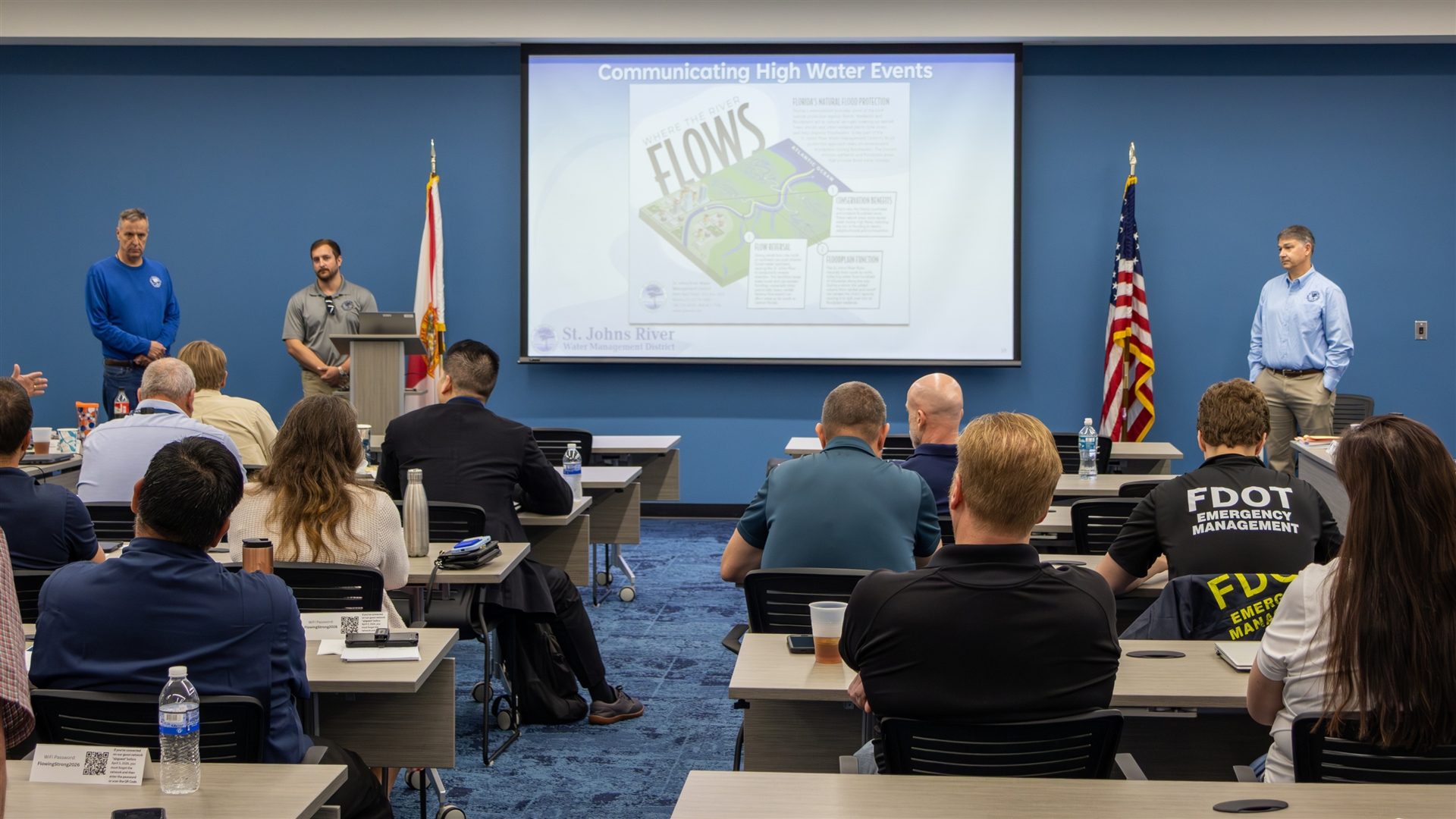
Ahead of the Atlantic hurricane season, key partners in hurricane preparedness and flood management gathered for the Central Florida Coordination Meeting hosted by the St. Johns River Water Management District (District).
Representatives from the South Florida Water Management District, the United States Army Corps of Engineers (USACE), the National Weather Service, the Florida Flood Hub, the Florida Department of Transportation and the East Central Florida Regional Planning Council, along with Orange, Seminole and Osceola counties and municipalities including Orlando, Winter Park, Altamonte Springs, Apopka, Kissimmee, Lake Mary, Longwood, St. Cloud, Winter Garden and Winter Springs, met to share updates and strategies to strengthen regional resilience.
Held at the District’s Apopka Service Center, the meeting focused on critical flood control improvement projects, improving communication and strengthening interagency coordination to better prepare for and respond to flooding risks associated with hurricanes and severe weather events across Central Florida. The District’s core missions of flood protection, natural systems, water quality and water supply are all directly influenced by storm events, making collaboration with regional partners essential ahead of hurricane season.
“Effective hurricane preparedness begins long before the first storm forms,” said the District’s Chief Resilience Officer, Tom Frick. “Even if forecasts call for a below-average season, it only takes one storm to make an impact. That’s why we come together with regional partners ahead of the season to share resources, strengthen coordination and ensure we’re prepared.”
The meeting opened with an outlook on the upcoming hurricane season from National Weather Service meteorologist Will Ulrich. While hurricane season runs from June 1 through Nov. 30, Ulrich noted that Florida has historically experienced more hurricane landfalls in October than in any other month. He also highlighted recent improvements to National Weather Service forecast cones, along with a new experimental cone currently in development.
Chris Kinslow, the District’s emergency coordinating officer, provided an update on emergency management conditions, highlighting ongoing drought and elevated wildfire risk. He noted that wildfire response remains the District’s most frequent emergency activity and that above-average wildfire conditions are expected to persist through June.
The District’s Bureau of Water Resource Information also provided an educational presentation on extreme rainfall events and the conditions that can lead to reversals of flow in the St. Johns River. Technical Program Manager Michael Daly and Water Resource Data Manager Wyatt Timmons examined three historical reversal events, with Daly noting that the river drops only about 30 feet in elevation from its headwaters in Indian River County to its outfall in Mayport. Additional updates were provided by the Florida Flood Hub, USACE, South Florida Water Management District and participating counties.
Local government representatives shared updates on completed and ongoing flood management projects and identified opportunities to strengthen emergency coordination. With Central Florida’s complex topography and continued population growth, collaborative planning remains critical to reducing flood impacts and protecting public safety.
What Residents Can Do
Residents play an important role in community preparedness. Simple steps can make a big difference:
- Keep storm drains clear of debris
- Report clogged ditches to local governments
- Consider retrofitting homes for flood resistance
- Secure flood insurance through the National Flood Insurance Program
For more information on the District’s role in flood protection, storm preparedness and emergency response, visit www.sjrwmd.com/storm.
New to Florida or looking for a refresher on stormwater systems? Learn more about stormwater design, management and its limitations at www.sjrwmd.com/education/stormwater-systems.