Below-average rainfall continues across District for sixth consecutive month – SJRWMD

Below-average rainfall continues across District for sixth consecutive month

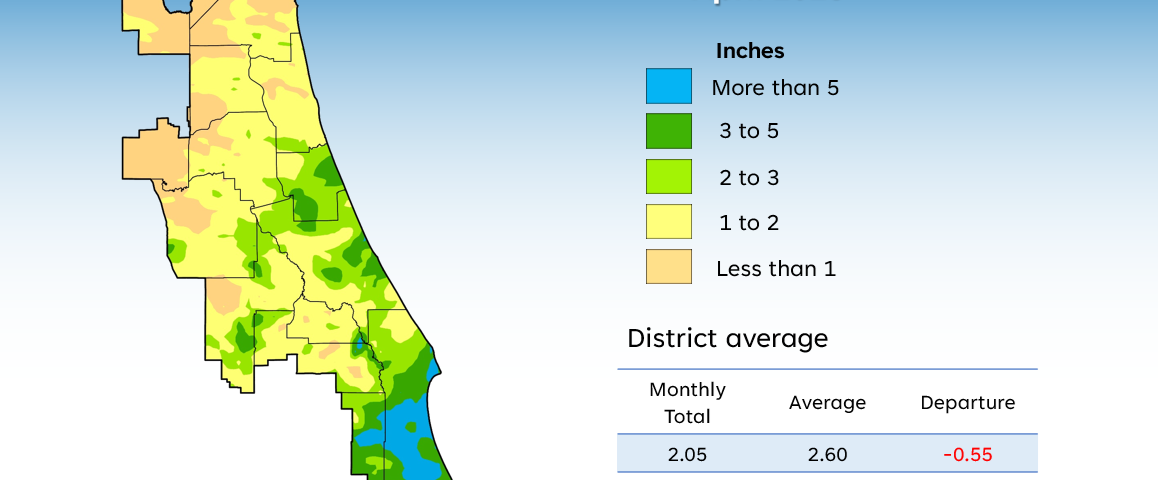
A map illustrates rainfall conditions in April across the St. Johns River Water Management District.
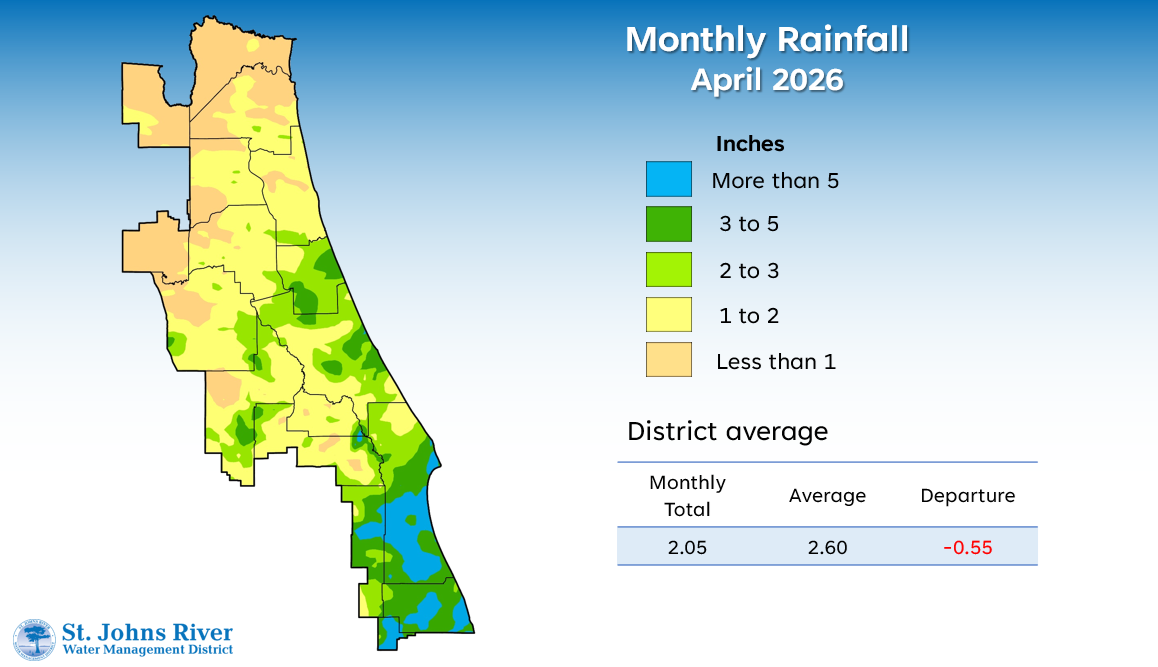

A map illustrates rainfall conditions in April across the St. Johns River Water Management District.
A map illustrates rainfall conditions in April across the St. Johns River Water Management District.

The District’s latest hydrologic conditions report shows drought conditions continuing across much of the region as April marked the sixth consecutive month of below-average rainfall. While portions of the southern District received significant rainfall during the first half of the month, conditions remained considerably drier across many northern and central counties. Over the past 12 months, 13 counties recorded rainfall totals below their historical averages, including seven counties that are more than 14 inches below normal.

As dry conditions persist, hydrologic indicators across the District continue to decline. Most aquifer levels decreased during April, and the majority of the Upper Floridan Aquifer remained below the normal range. Areas of low groundwater levels expanded across central counties, and areas of very low groundwater levels expanded in portions of both northern and central Florida.

These conditions align with broader statewide drought indicators. According to the latest U.S. Drought Monitor assessment released last week, most of the state is classified as either in severe or exceptional drought. A majority of the District’s northern region is classified as being in extreme drought, while portions of several counties in the south central District fell within the severe or moderate drought category.

A full report outlining April’s hydrologic conditions was presented at the District’s Governing Board meeting. Highlights include:

Rainfall

  • Districtwide rainfall averaged 2.05 inches, 0.55 inches below the monthly average.
  • Monthly averages ranged from 4.55 inches in Indian River County to 0.51 inches in Alachua County.
  • Annual rainfall across the District was 44.10 inches, 6.91 inches below the long-term average.
  • Rainfall distribution on an annual scale has been higher in Volusia and northern Brevard counties, while areas to the west and the northwest have received below 35 inches.
  • Five of the District’s 18-county region are currently recording above-average rainfall. Of the 13 counties that recorded below-average annual rainfall, seven were below their averages by 14 inches, including Alachua and Bradford counties, which were more than 19 inches below their annual averages, while Baker County was more than 22 inches below normal.

Groundwater 

  • Water levels in the Upper Floridan aquifer primarily recorded decreases, reflecting drier conditions.
  • Districtwide groundwater levels, expressed as a single index, were in the 22nd percentile for April, which is within the low range.   

Spring flows

  • Silver Springs recorded a monthly mean flow of 469 cubic feet per second (cfs), or 303 million gallons per day (mgd), a decrease of 23 cfs from March, remaining in the low range for this time of year.
  • In Volusia County, the Blue Spring station reported flows to be in the normal range.
  • Rock Springs had a monthly mean flow of 58 cfs (37 mgd), which is in the normal range.
  • Wekiwa Springs recorded a monthly mean flow of 61 cfs (40 mgd), continuing to be in the normal range.

For further insights into rainfall totals and other hydrologic data, visit www.sjrwmd.com.  

For more information about the Phase III Extreme Water Shortage, visit www.sjrwmd.com/wateringrestrictions.

Visit WaterLessFlorida.com for tips to help landscapes thrive while saving water and money. Follow the water conservation conversation at #sjrwmd #waterconservation #savewater.