Drought conditions persist as July rainfall remains below average – SJRWMD

Drought conditions persist as July rainfall remains below average

A map illustrates rainfall conditions in July across the St. Johns River Water Management District.
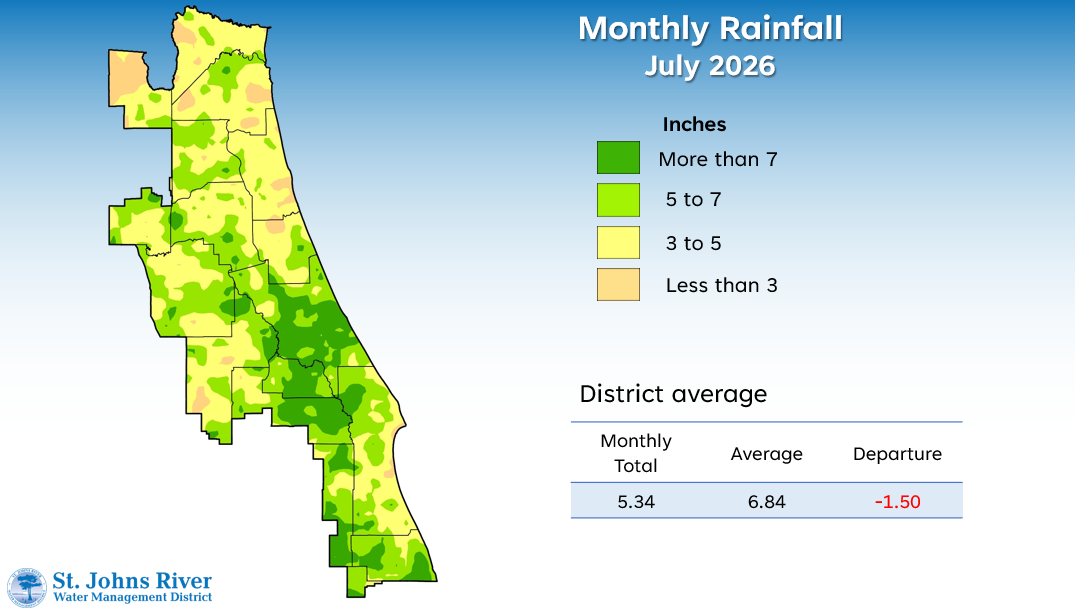
A map illustrates rainfall conditions in July across the St. Johns River Water Management District.

Rainfall across the St. Johns River Water Management District (District) remained below average in July, with drought conditions continuing across portions of western and northern counties. Although southern areas experienced modest improvements in groundwater levels, the majority of the Upper Floridan aquifer remained below the normal range. Continued below-average rainfall and low groundwater levels highlight the importance of water conservation as the District continues to monitor drought conditions.

July is typically part of Florida’s summer wet season, when rainfall generally exceeds the more than 5 inches of water lost through evapotranspiration each month, helping replenish groundwater levels. This year, however, rainfall patterns varied from historical trends, with less rainfall in many northern counties and more rainfall in eastern-central and southern portions of the District.

A full report outlining July’s hydrologic conditions was presented at the District’s Governing Board meeting. Highlights include:

Rainfall

  • Districtwide rainfall averaged 5.34 inches, 1.50 inches below the monthly average.
  • Monthly rainfall averages ranged from 6.99 inches in Seminole County to 3.50 inches in Baker County.
  • Annual rainfall across the District was 51.01 inches, 9.03 inches below the 12-month average.
  • Rainfall totals over the past year remained uneven across the District. Volusia and Brevard counties were the only counties above normal for the previous 12 months. Sixteen of the District’s 18 counties remained below average, with Baker County recording a deficit of more than 20 inches.

Groundwater 

  • Most monitoring stations across the Upper Floridan aquifer were below the normal range at the end of July, and areas of very low levels expanded in northern counties.
  • Districtwide groundwater levels, expressed as a single index, were in the 15th percentile for July, which is in the low range.

Spring flows

  • Silver Springs recorded a monthly mean flow of 351 cubic feet per second (cfs), or 227 million gallons per day (mgd), a decrease of 33 cfs from June, which is at the bottom of the very low range for this time of year.
  • In Volusia County, the Blue Spring station reported flows within the normal range.
  • Rock Springs had a monthly mean flow of 57 cfs (37 mgd), which is in the normal range.
  • Wekiwa Springs recorded a monthly mean flow of 60 cfs (39 mgd), continuing to be in the normal range.

For further insights into rainfall totals and other hydrologic data, visit www.sjrwmd.com.  

For more information about the Phase III Extreme Water Shortage, visit www.sjrwmd.com/wateringrestrictions.

Visit WaterLessFlorida.com for tips to help landscapes thrive while saving water and money. Follow the water conservation conversation at #sjrwmd #waterconservation #savewater.