Continued rainfall needed despite near-average August totals – SJRWMD

Continued rainfall needed despite near-average August totals

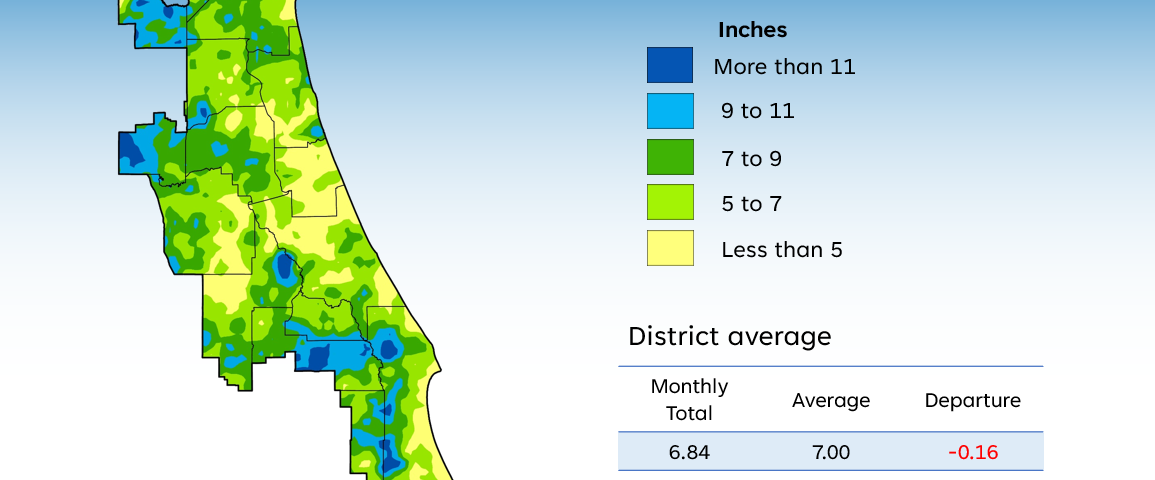
A map illustrates rainfall conditions in August across the St. Johns River Water Management District.
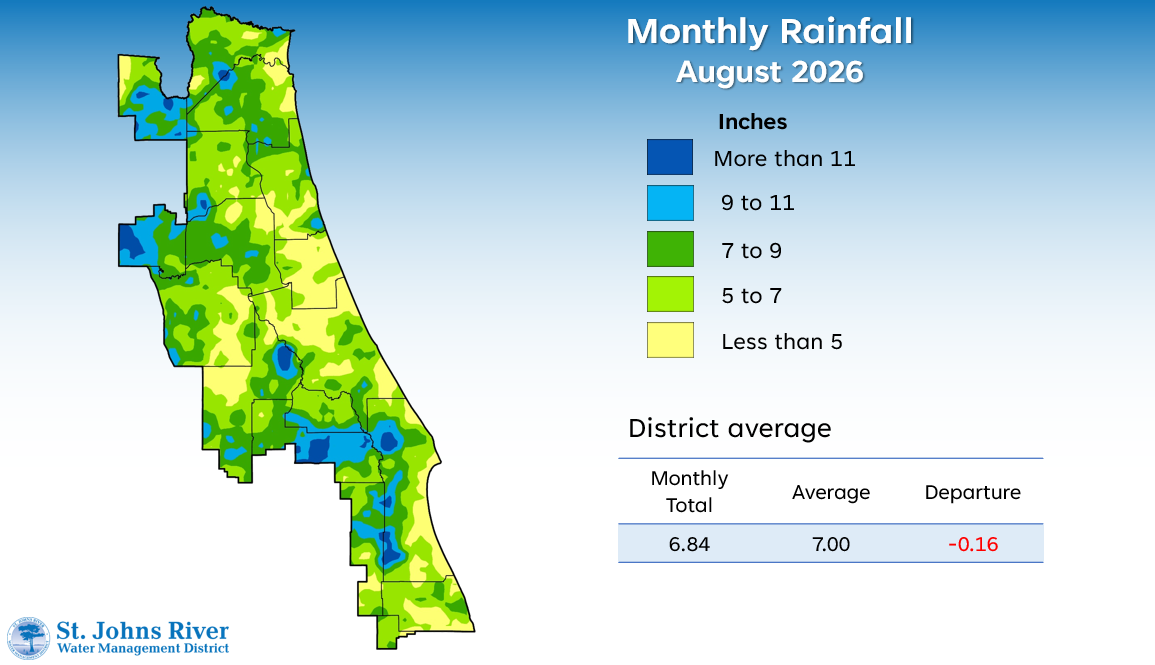

A map illustrates rainfall conditions in August across the St. Johns River Water Management District.
August brought a return to more typical summer rainfall patterns across the St. Johns River Water Management District. While rainfall totals varied considerably across the region, several inland counties received above-average rainfall, helping improve conditions in some previously dry areas.

The District averaged 6.84 inches of rainfall during the month, just below the long-term August average of 7 inches. Eight counties received above-average rainfall, including several counties that had experienced persistent rainfall deficits in recent months.

Evapotranspiration (ET), the naturally occurring combination of water loss through evaporation and plant use, is an important component when looking at rainfall amounts. In August, ET averaged nearly 5 inches across the District, while average rainfall reached 6.84 inches. Although rainfall exceeded ET water losses, long-term recovery is dependent on consistent surplus rainfall to replenish groundwater, restore water levels and reduce rainfall deficits.

A full report outlining August’s hydrologic conditions was presented at the District’s Governing Board meeting. Highlights include:

Rainfall

  • Districtwide rainfall averaged 6.84 inches, 0.16 inches below the monthly average.
  • Monthly rainfall averages ranged from 9.73 inches in Alachua County to 4.71 inches in Flagler County.
  • Annual rainfall across the District was 41.41 inches, 9.60 inches below the 12-month average.
  • Rainfall totals over the past year remained uneven across the District. However, all 18 counties were below their 12-month averages, with eleven counties recording deficits of more than 10 inches. Of those, Baker County recorded a deficit of more than 19 inches.

Groundwater 

  • Most monitoring stations across the Upper Floridan aquifer were below the normal range at the end of August.
  • Districtwide groundwater levels, expressed as a single index, were in the 9th percentile for August, which is in the very low range.   

Spring flows

  • Silver Springs recorded a monthly mean flow of 381 cubic feet per second (cfs), or 246 million gallons per day (mgd), an increase of 8 cfs from July, which is in the very low range for this time of year.
  • In Volusia County, the Blue Spring station reported flows within the normal range.
  • Rock Springs had a monthly mean flow of 55 cfs (36 mgd), which is in the normal range.
  • Wekiwa Springs recorded a monthly mean flow of 61 cfs (40 mgd), continuing to be in the normal range.

For further insights into rainfall totals and other hydrologic data, visit www.sjrwmd.com.  

For more information about the Phase III Extreme Water Shortage, visit www.sjrwmd.com/wateringrestrictions.

Visit WaterLessFlorida.com for tips to help landscapes thrive while saving water and money. Follow the water conservation conversation at #sjrwmd #waterconservation #savewater.