News, meetings and notices
In this section
Subscribe
Receive timely and pertinent information about the District, water resource issues, upcoming key meetings, the District’s blog, opportunities for public input and involvement, events and water resource decisions affecting northeast and east-central Florida by email.
News media
See news releases issued by the District and obtain media contact information.
District blog
Access the current blog and archived editions.
Get the facts
Get the facts about water resource issues in the news.
RSS feeds
Subscribe to RSS (really simple syndication) feeds to receive current and updated information from the District.
Meetings
Access the schedule of District meetings on a variety of subjects, including
Announcements
- Temporary website outages
- Office closures
- Land closures
- Flooding information
- News and notices from other agencies and groups
District feature publications
Learn more about water resource issues and District programs and projects through the District’s feature publications. Read online or subscribe to receive a paper copy in the mail.
May 9, 2012
Lake level management meeting, May 31
The St. Johns River Water Management District will hold a public meeting on May 31 at 6 p.m. to discuss potential water level management options for the Harris Chain of Lakes for the upcoming year. The system includes lakes Apopka, Dora, Harris, Eustis, Yale, Little Lake Harris (the “Super pond”), Griffin and three water control structures — Apopka-Beauclair, Burrell and Moss Bluff locks and dams. Public input on the proposed management options will be welcomed at the meeting. Following the meeting, the District’s Governing Board will consider low-flow discharges and lake regulation schedules for the next year at a June 12 public meeting in Palatka.
The meeting also will include an update on the schedule and process for developing minimum flows and levels. The meeting will be held at the Paul P. Williams Fine Arts Center, Lake Sumter Community College, Leesburg Campus, 9501 U.S. Highway 441, Leesburg, FL 34788.
Stakeholder representatives on north Florida water supply issues named
Twelve representatives have been named to the North Florida Regional Water Supply Partnership’s stakeholder committee, an advisory body that will share viewpoints of stakeholder groups with the St. Johns River and Suwannee River water management districts and the Florida Department of Environmental Protection (DEP) to help address the region’s water supply issues.
Chosen to represent the groups, organizations and entities that have an interest in the region’s water supply, committee members are:
- Public water supply: Ray O. Avery, Clay County Utility Authority; David Clanton, City of Lake City Utilities
- Commercial/power generation: Athena T. Mann, JEA; James Cornett, Cornett’s Spirit of the Suwannee Inc.
- Industrial/mining: J. Michael O’Berry, Vulcan Materials Co.; Stan Posey, PCS Phosphate
- Agriculture: Kerry Kates, Florida Fruit and Vegetable Association; Thomas Harper, Harper Farms
- Environmental: Patrick T. Welsh, University of North Florida and Save Our Lakes; Jacqui Sulek, Audubon Florida
- Local government: Keystone Heights Mayor Mary Lou Hildreth; Dixie County Commissioner Gene Higginbotham
The St. Johns District received 18 applications, and the Suwannee District received 24.
“We are pleased with the broad interest in the partnership,” says Charlie Houder, Suwannee River District acting executive director. “The committee represents a wide range of expertise that will serve as a valuable asset to assist the districts and DEP in the development of sustainable water supplies.”
“One of DEP’s top priorities is getting Florida’s water right. The joint Regional Water Supply Planning process is an important step toward ensuring an adequate water supply for North Florida,” says Ann B. Shortelle, DEP Water Policy Director. “I want to thank the members of the stakeholder committee for volunteering to bring ideas to the table that can help meet our state’s future water needs and protect our valuable water resources.”
The committee is structured such that a wide range of public interests are included, while keeping the committee small enough to be effective and productive.
“Stakeholder committee representatives will closely coordinate with the constituencies they represent, as well as being responsive to the interested public,” says Hans G. Tanzler III, St. Johns District executive director. “Our goal is that the process be open and inclusive.”
Committee meetings will be open to the public, so stakeholders beyond the committee membership can attend and participate.
May 8, 2012
Enhanced water conservation needed during drought
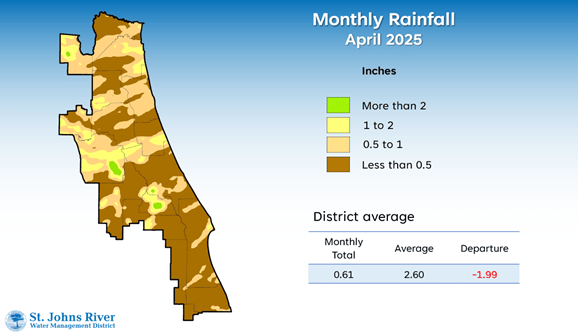
Rainfall levels are well below normal and some water bodies are at or near record lows in northeast and central Florida, prompting the St. Johns River Water Management District Governing Board to urge businesses and the public to actively conserve water.
The District is continually monitoring water levels for any signs of supply problems and ecosystem impacts. Without increased rainfall and enhanced water conservation, those impacts could begin to be widely experienced, which could prompt the District to take additional water conservation steps.
Rainfall in the 18-county District is 12 ½ inches below normal for the last 12 months. The lack of rainfall has been especially significant in the northern portion of the District where Duval County is 15 to 25 inches below normal in rainfall for the past 12 months. The Gainesville area is approximately 25 inches below normal in rainfall in the past 12 months.
The lack of rainfall has resulted in very low groundwater levels throughout the District and record lows have been recorded in some areas during the last month. Surface water levels continue to decline and some water bodies, such as Lake Weir in Marion County, have reached record lows.
“Our communities are increasingly sensitive to the need to conserve water,” said District Executive Director Hans Tanzler. “Now is the time for all of us to do everything we can to conserve.”
Current watering restrictions limit outdoor irrigation to no more than two designated days per week and not between 10 a.m. and 4 p.m.